Connect with us

#SustainableHarvard

Get involved on campus

Whether you are a student, staff member, alum, or simply interested in learning more about sustainability at Harvard, we invite you to connect and get involved with this important work. Contact the Office for Sustainability at sustainability@harvard.edu.
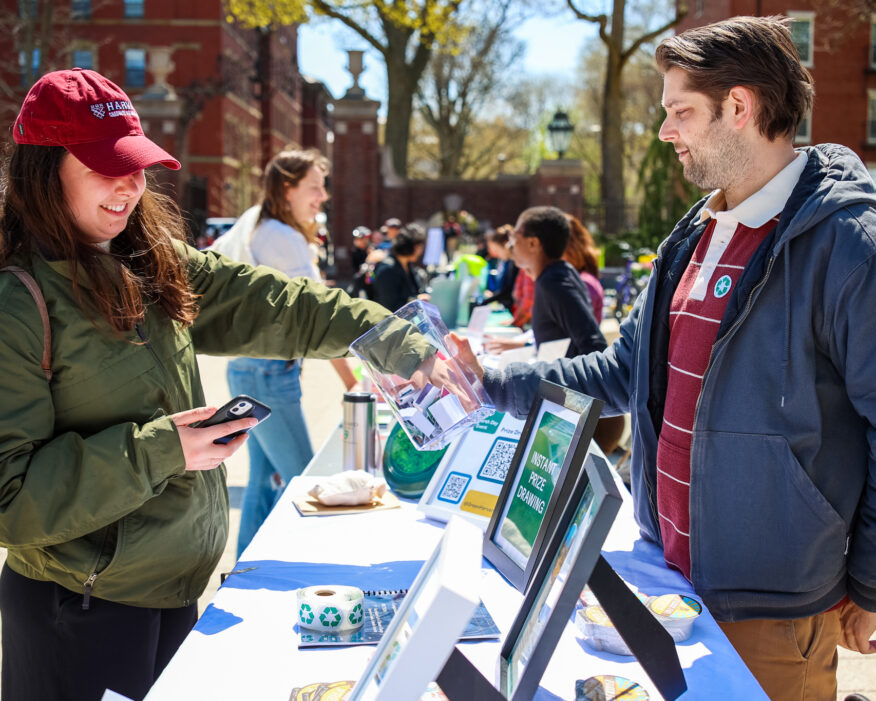
2023.04.21_OFS Earth Day Event-05

Connect with #SustainableHarvard

text that says #SustainableHarvard with chat bubble icons against a green background.

Receive news from the Harvard Office for Sustainability

* indicates required

Upcoming Events

September

18

Multi-day Event

Global to Local to Global Geodesign for Climate Change Mitigation | (GLG) Workshop

Friday 9/18 12pm-1pm – Introductory Presentation
Saturday 9/19 9am-5:30pm – GLG Workshop & Reception

The Global to Local to Global (GLG) Climate Mitigation Project, in collaboration with Esri, has initiated an innovative workflow to address climate change mitigation through a structured framework designed to implement global-to-local-to-global projects. The GLG strategy creates a scalable geodesign workflow compatible across global, Nationally Determined Contributions (NDCs) and diverse jurisdictions and geographic scales directed to projected environmental changes by 2050. It utilizes climate science and optimization designs to inform national to local designs– which, in turn, informs national and global policy, as local implementation is vital for building climate resilience.

Geodesign – design at geographic scale – provides a collaborative approach that integrates multiple disciplines and uses geographical information systems (GIS)-based analytic and design tools to help explore alternative future scenarios in response to stated problems. In this workshop, participants will work in groups to simulate commitments to climate mitigation projects at the regional or local scale, in consultation with national NDCs, climate, land use, land cover, and bio-regional data and their projections to 2050. Their selections will be used to quickly generate a global geospatial model of climate-driven scenarios resulting from combined mitigation actions, to which groups will be asked to respond to how global and national outcomes may inform future design conditions.

This in-person workshop is open to all from Harvard/MIT and participants from the broader academic community. No prior knowledge of GIS is required.

September

17

Thursday
3:30 pm-4:30 pm GMT+0000

OEB Seminar Series: Randi Rotjan

Randi Rotjan , Associate Professor of Biology , Tufts University | Protecting Global Oceans in the Anthropocene

Abstract: The oceans are 71% of our planet, and yet are still largely unexplored, especially in the deep and open oceans. New species are discovered on almost every deep-sea dive, and even with increased exploration efforts, we are still discovering massive underwater mountains, canyons, and other features. Yet, even with so much unknown, decisions cannot wait for discovery. In an era of global change, biological communities in even the most remote parts of our planet are feeling the impact of human societies and are vulnerable to depletion or extinction. To combat this, global targets for protection have set a goal of protecting 30% of oceans by 2030. This seminar will unpack the science behind large scale marine conservation, and discuss how to explore the unexplored, and how to protect the unprotected.

September

16

Wednesday
4:30 pm-5:30 pm GMT+0000

Harvard Voices on Climate Change: El Niño In a Warming World

The Salata Institute and the Harvard Alumni Association invite you to the latest installment of Harvard Voices on Climate Change, a virtual series featuring Harvard faculty and fellows on different dimensions of the climate challenge.

This session will explore El Niño in a warming world and what a changing climate could mean for this powerful driver of global weather patterns. Featuring Peter Huybers, Professor of Earth and Planetary Sciences and Professor of Environmental Science and Engineering, the discussion will examine how our understanding of El Niño is evolving, its far-reaching impacts, and what we may expect as the planet continues to warm.

September

16

Wednesday
1:00 pm-1:45 pm GMT+0000

Wildfire Smoke: The Health and Environmental Impacts

This summer, wildfire smoke degraded air quality across parts of Canada, the U.S., and other regions. In this event, experts will explain how wildfire smoke affects the lungs, heart, and body; who is most at risk; and how to reduce exposure. The discussion will cover practical steps for individuals, schools, and workplaces, including improving indoor air filtration, using portable air cleaners, and wearing protective masks.

September

15

Tuesday
9:00 am-10:15 am GMT+0000

Why Harvard Should Care About the Arctic: Community Networking Breakfast

The Arctic is warming four times faster than the global average, with impacts that extend far beyond the region. Connect with Arctic researchers from across Harvard at a networking breakfast hosted by the Belfer Center’s Arctic Initiative.

Over coffee and bagels, you’ll have a chance to give a lightning presentation to share your work and make a case for why Harvard should engage more deeply with the Arctic. You’ll also hear from members of the Arctic Initiative on climate change, conservation, health, community resilience, and geopolitics.

If you’re curious about the Arctic, come listen and learn how changes in the region may affect your work – and how you can help shape a resilient, cooperative, and peaceful future for the region.

This session is open to Harvard University ID holders. Registration required.