• Science Spotlights: The Case of the Immortal Chemicals & Learning about the Deep Past from Ancient DNA

    Harvard Museum of Natural History 26 Oxford Street, Cambridge, MA, United States

    Meet up-and-coming scientists and learn about questions at the forefront of research today in this series of short talks.

    2:00–2:30 pm – The Case of the Immortal Chemicals
    Speaker: Ethan Sontarp, Graduate Student with the Sunderland Group

    There’s a mystery that needs to be solved: where does invisible pollution go when it is released into the environment? Scientists use chemical fingerprinting to do detective work, uncovering why certain man-made pollutants are so resistant to breaking down and where they like to go. By following this trail of clues, researchers can learn how to stop pollution from entering our food and drinking water. Join Harvard scientist Ethan Sontarp to discover how environmental detective work can help protect the world around us.

    3:00-3:30 pm – Learning about the Deep Past from Ancient DNA
    Speaker: Daniel Tabin, PhD Student in the David Reich Lab

    Writing has only been around for about 6,000 years. This means that the stories of people who lived before that time were never recorded for future generations. Thankfully, these stories are not lost forever. How can we learn about the adventures, relationships, and challenges of people who lived long before anyone ever put words on a page? Join Harvard scientist Daniel Tabin to discover how ancient DNA can help us piece together the lives of people who lived thousands of years ago—and hear about the remarkable stories he has helped bring back to light.

    20-minute talk followed by 10-minute Q&A session. Recommended for ages 10 and up.
    Regular museum admission rates apply.

    Presented by the Harvard Museum of Natural History and Harvard Museums of Science & Culture
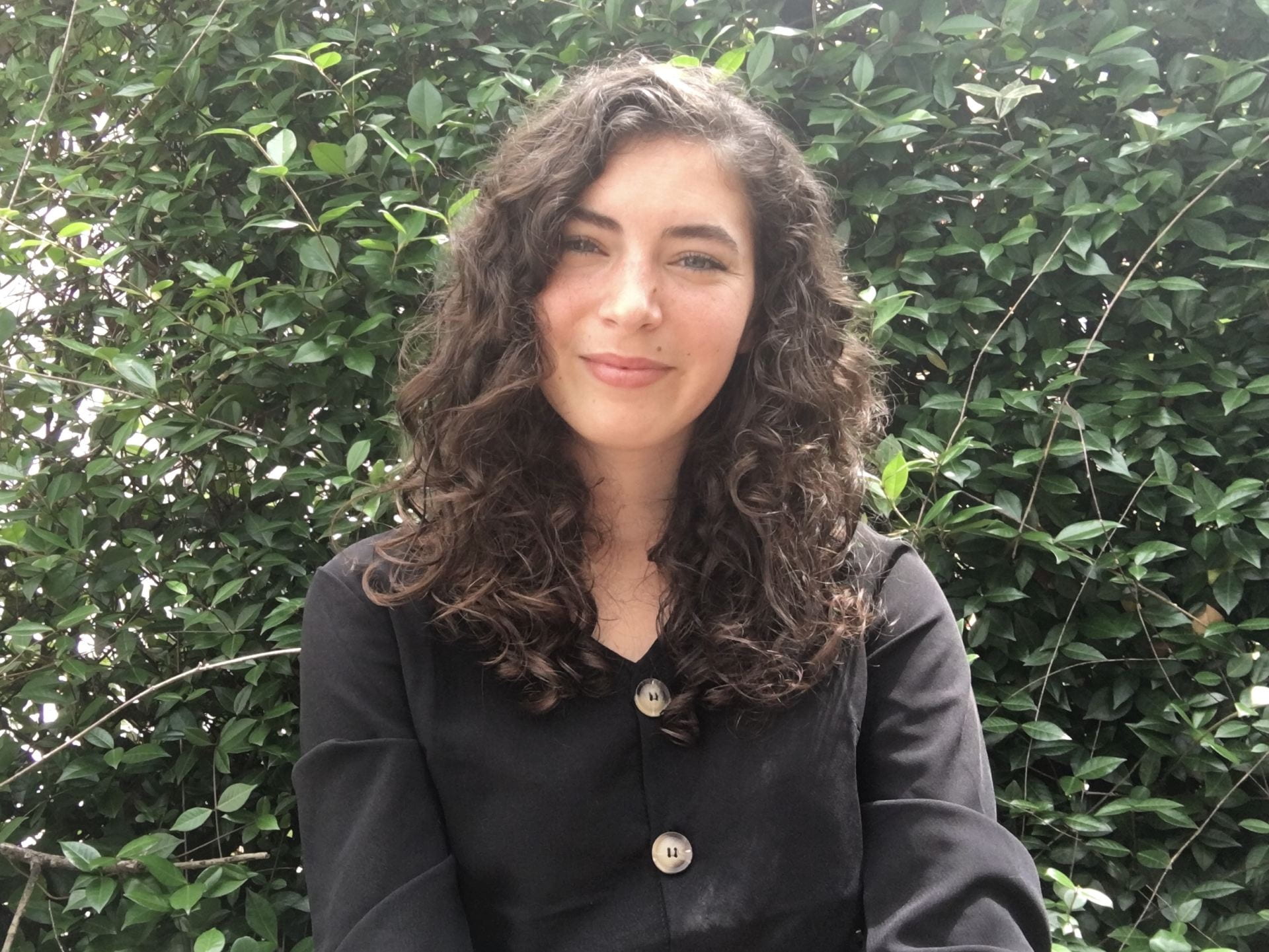
  • Science Spotlights: Short of Breath? Here’s a Rock

    Harvard Museum of Natural History 26 Oxford Street, Cambridge, MA, United States

    When we think of electricity, we often picture wires, circuits and generators. But did you know that living things can also produce electricity? In fact, electricity powers many of the biological processes in living things, including us! Even more surprising is that bacteria can use electricity to “breathe rocks.” What does this mean exactly? Join Harvard scientist Federica Calabrese as she uncovers how some microbes evolved to live in oxygen-free environments and how we can harness “bioelectricity” to power our own electronic devices.

    20-minute talk followed by 10-minute Q&A session. Recommended for ages 10 and up.
    Regular museum admission rates apply.

    Presented by the Harvard Museum of Natural History and Harvard Museums of Science & Culture.

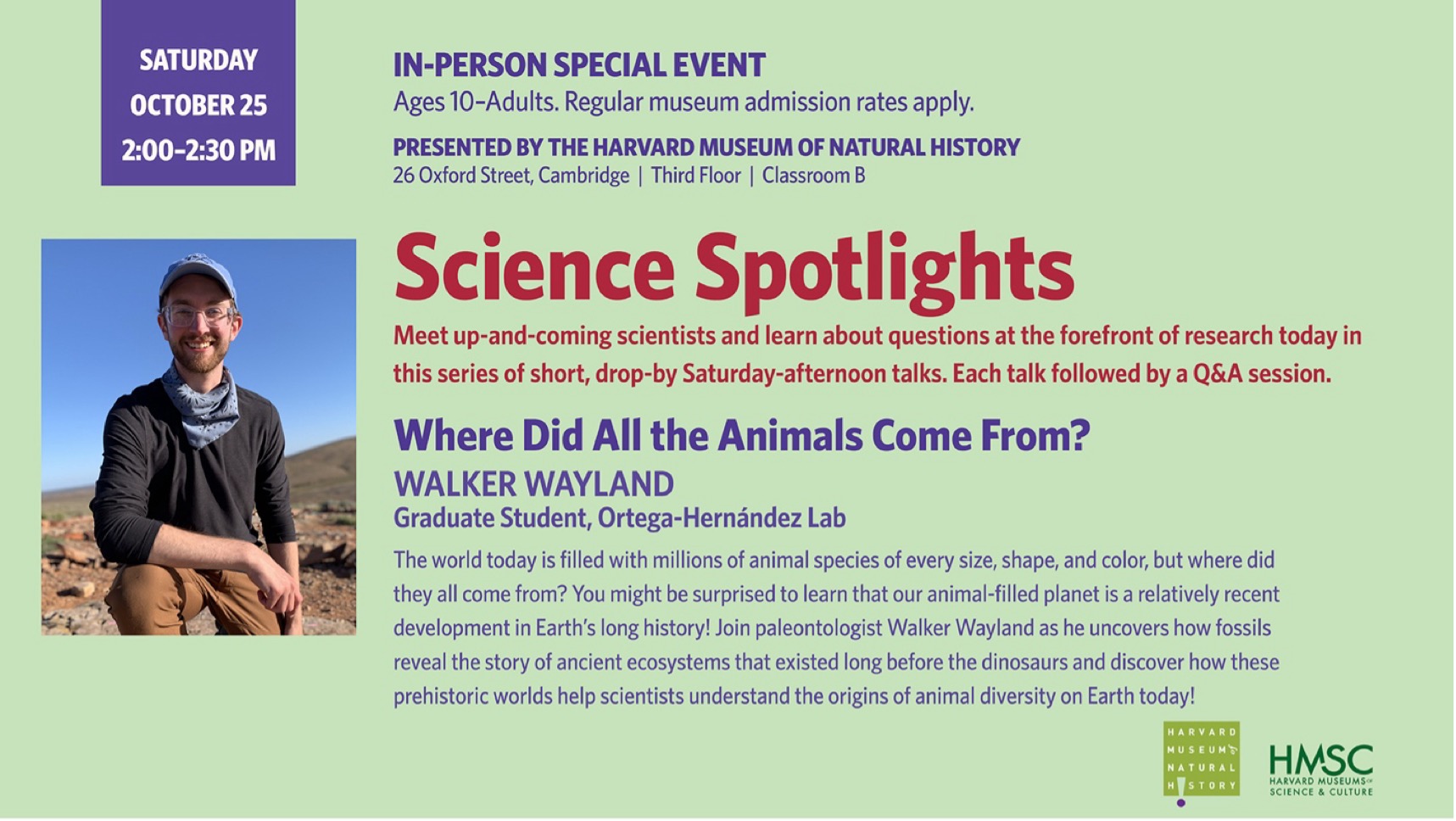
  • Science Spotlights: Where Did All the Animals Come From?

    Harvard Museum of Natural History 26 Oxford Street, Cambridge, MA, United States

    The world today is filled with millions of animal species of every size, shape, and color, but where did they all come from? You might be surprised to learn that our animal-filled planet is a relatively recent development in Earth’s long history! Join paleontologist Walker Wayland as he uncovers how fossils reveal the story of ancient ecosystems that existed long before the dinosaurs and discover how these prehistoric worlds help scientists understand the origins of animal diversity on Earth today!

    Presented by the Harvard Museum of Natural History and Harvard Museums of Science & Culture.

  • Exploring the World of Rot

    Harvard Museum of Natural History 26 Oxford Street, Cambridge, MA, United States

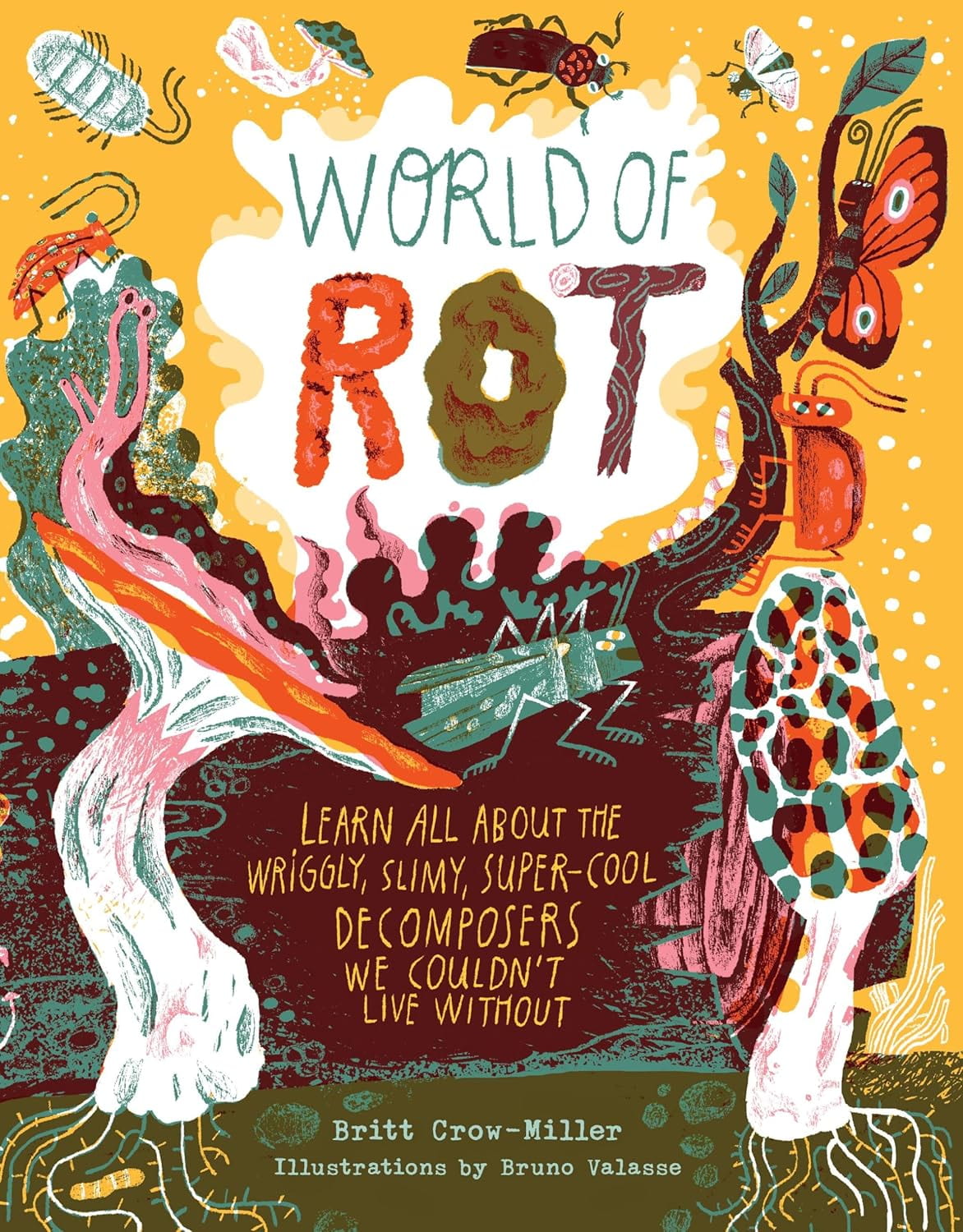
    We may not always notice, but our world is rotten. Rot—the process of breaking down once-living materials of our planet—is, in fact, a major part of what makes our world livable. Join environmental educator Britt Crow-Miller for a fun, curiosity-filled and hands-on journey through her book, World of Rot (Storey Publishing, 2024). In this one-hour session, participants will learn the what, where, when, and why of decomposition and get up close to some of the organisms at work in nature’s recycling system. Get ready to meet some hungry fungi, slimy slugs, and wiggly worms–some of these will be alive!

  • Science Spotlights: Finding New Species

    Harvard Museum of Natural History 26 Oxford Street, Cambridge, MA, United States

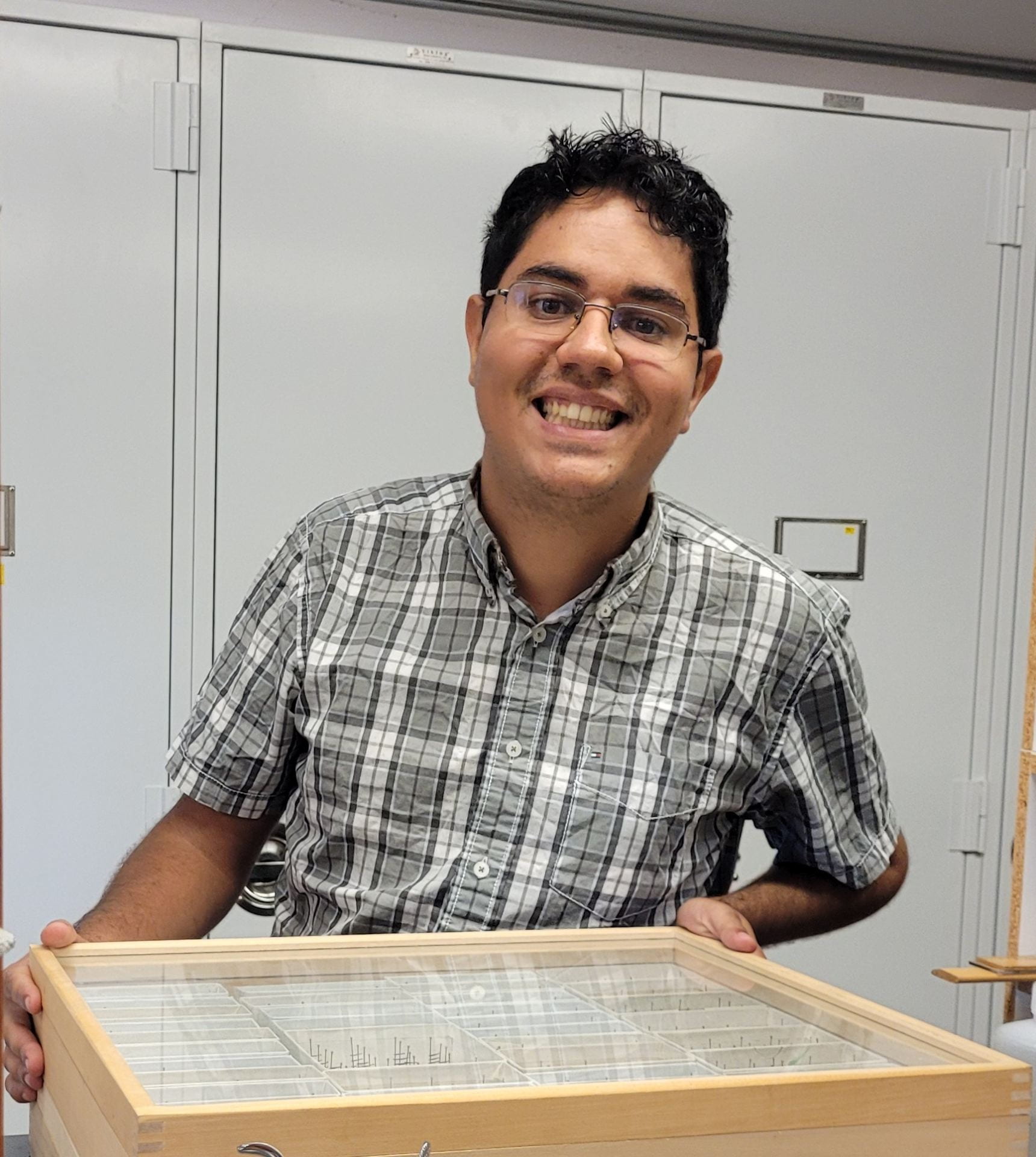
    Scientists estimate that there are over 7.5 million species of plants and animals that have yet to be discovered and described. But in a world in which extinction may outpace discovery, how can citizen scientists get involved? Join me as I share how residents in Alaska helped me discover and describe a new species of snake worm gnat and learn how you, too, can participate in the scientific process.

  • ArtsThursdays: Sea Monsters

    Harvard Museum of Natural History 26 Oxford Street, Cambridge, MA, United States

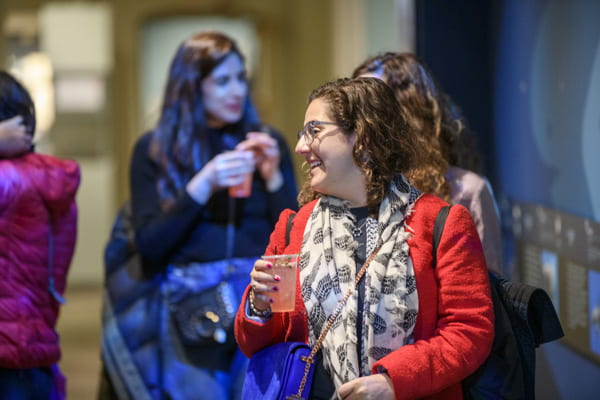
    Join us for a free, fun night at the Harvard Museums of Science & Culture! Come with a date, come with friends, or make new friends while strolling through the galleries. Visit the exhibition Sea Monsters: Wonders of Nature and Imagination and explore the allure of serpents, krakens, and other mysterious creatures of the deep sea. Let your imagination run wild and create a felt sea “monster” with Alex Makes Art. Suggested ages 10 and up. Guided by visual artist Kat Owens, participate in the creation of a community art piece, and reflect on the impact of plastics on marine animals. Meet scientists from Harvard’s Bellono Lab to learn about the behavior and unique characteristics of octopuses. Learn about unique, unusual—and even spooky—marine specimens in the Museum of Comparative Zoology. Purchase drinks at the cash bar (valid government ID required to consume alcoholic beverages). Embark on a scavenger hunt to find sea monsters in the museum! Free and open to the public.

  • National Fossil Day

    Harvard Museum of Natural History 26 Oxford Street, Cambridge, MA, United States

    What treasures are found in the Harvard University paleontology collections? Meet Harvard paleontologists to find out! See their favorite fossils, learn about their research, and ask them your questions. Join us to celebrate National Fossil Day with short talks and table-top presentations for all ages.

    Regular museum admission rates apply. Presented in collaboration with the Stephanie Pierce Lab of Vertebrate Paleontology and the Javier Ortega-Hernández Lab of Invertebrate Paleontology. Free event parking at the 52 Oxford Street Garage.

  • Celebrating Birds: A Papier Mâché Workshop

    Harvard Museum of Natural History 26 Oxford Street, Cambridge, MA, United States

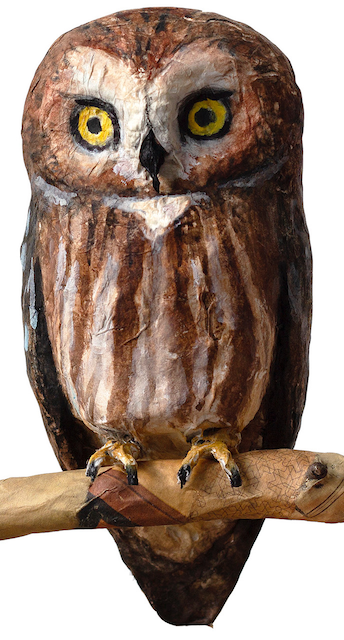
    In this workshop, you will use museum specimens to inspire your own avian creation. Over five half days, artist Gail Boyajian will guide you from start to finish as you build and paint a papier mâché bird from scratch, using everyday materials.

    We will complement the art-making process with visits to the museum galleries as well as the ornithology research collections.

  • ArtsThursdays: Edible Insects and More!

    Harvard Museum of Natural History 26 Oxford Street, Cambridge, MA, United States

    Join us for a free, fun night at the Harvard Museums of Science & Culture. Come with a date, come with friends, or make new friends while strolling through the galleries. Explore the new exhibit: Ants and Termites: Nature’s Super Organisms and participate in fun activities.

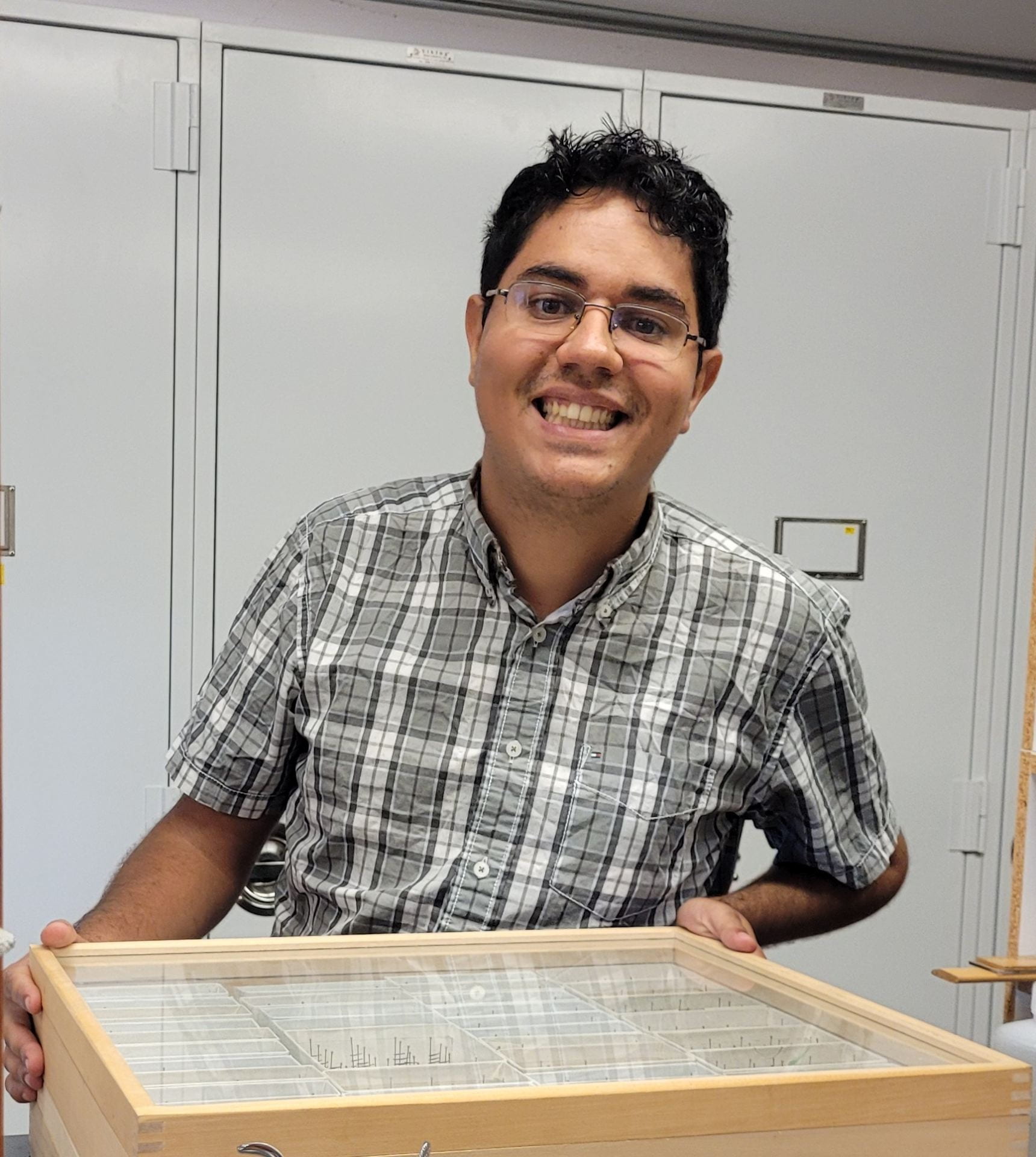
  • Science Spotlights: How to Help a Scientist Find a New Species

    Harvard Museum of Natural History 26 Oxford Street, Cambridge, MA, United States

    Meet up-and-coming scientists and learn about questions at the forefront of research today in this series of short talks.

    How to Help a Scientist Find a New Species

    Speaker: Thalles P. Lavinscky Pereira, PhD. Farrell Lab

    Scientists estimate that there are over 7.5 million species of plants and animals that have yet to be discovered and described. But in a world where extinction may outpace discovery, how can citizen scientists get involved? Join me as I share how residents in Alaska helped me discover and describe a new species of snakeworm gnat and learn how you, too, can participate in the scientific process.

  • I ♥ Science

    Harvard Museum of Natural History 26 Oxford Street, Cambridge, MA, United States

    Break out of the winter doldrums and let your inner scientist loose. Meet amateur and professional scientists who study and collect fossils, mushrooms, and meteorites. Talk with experts who build telescopes, track invasive species, and grow carnivorous plants. Try your hand at finding bugs or exploring sand. Craft a piece of art from polarized light. Watch a live ice sculpture demonstration in front of the museum. This popular annual event has something for everyone and is appropriate for children and adults of all ages.

    Regular museum admission rates apply.

    Free parking is available at the 52 Oxford Street Garage.

  • Science Spotlights: Fantastic Flowers and Their Many Forms

    Harvard Museum of Natural History 26 Oxford Street, Cambridge, MA, United States

    Hear from speaker Andrea Appleton, Harvard Kramer Lab Graduate Student, on the importance of the evolution of flowers and the breadth of their diversity. Flowers exhibit extreme variation in their shape, size, color, and even the type of parts they are made of, but how? Let’s break some of the coolest flowers down to their basic components and talk about how floral variation has evolved. Learn more about this important topic. Event recommended for ages 10 and up.