Forest Futures: Will the Forest Save Us All?
The Harvard University Graduate School of Design will host a two-day academic conference alongside its new exhibition, Forest Futures.
The Harvard University Graduate School of Design will host a two-day academic conference alongside its new exhibition, Forest Futures.
Please join us on Wednesday, November 20, 2024, 12:30-2:00 PM ET for a virtual presentation by Harvard’s Julie Battilana. Julie Battilana is a professor of organizational behavior at Harvard Business School and social innovation at Harvard Kennedy School, where she is also the founder and faculty chair of the Social Innovation + Change Initiative. Professor Battilana's research examines the politics of change in organizations and in society. She’s especially focused on organizations and individuals that initiate and implement changes that diverge from the taken-for-granted norm—that break with the status quo.
Cape Ann Conversations are hosted by the Harvard GSD’s Office For Urbanization. These convenings form a portion of the ongoing multi-year climate adaptation research project for Cape Ann, Massachusetts undertaken in collaboration with TownGreen, the Water Alliance, and the Town of Manchester-by-the-Sea.
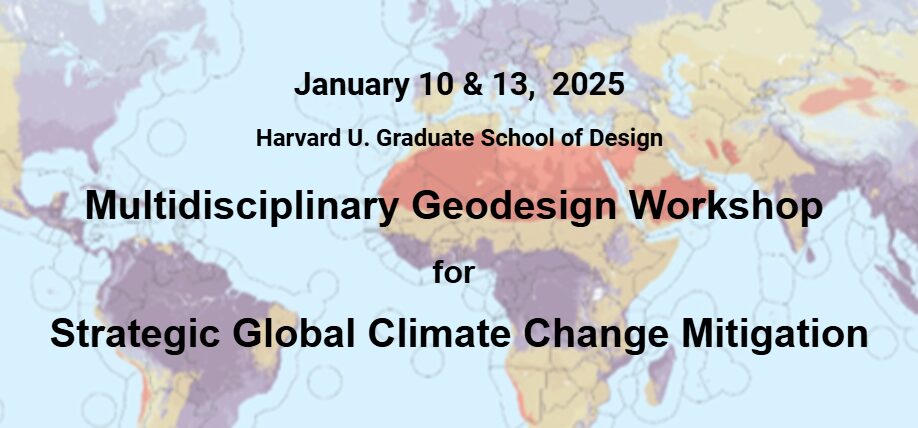
This 2-day workshop (January 10 and January 13) will expose participants from all schools, departments and disciplines at Harvard to an emergent data-driven geodesign framework for designing at the largest size imaginable – global – to identify feasible strategies to substantially reduce GHG emissions, the single most important global action available for countering cataclysmic global warming.
Participants will be assigned to represent national ‘climate-regions’ covering the entire globe (not necessarily their own, though local knowledge will help), focusing on a menu of possible climate mitigation project types, and their local and global spatial and temporal interconnections.) Based on initial proposed project-timelines of actions (Gantt charts) across the globe produced in Day 1, off-site computer simulations will be run over the weekend to predict likely climate modification outcomes. In Day 2, negotiation techniques will be used to find incremental improvements, resulting in an initial global strategic plan for carbon reduction.
No special prior experience is required. Geographic, cultural and disciplinary diversity is desired, and basic computer skills should suffice. A willingness to think big, and to engage in holistic systems thinking will help. We especially seek participants from or with experience in as many countries and climate regions as possible.
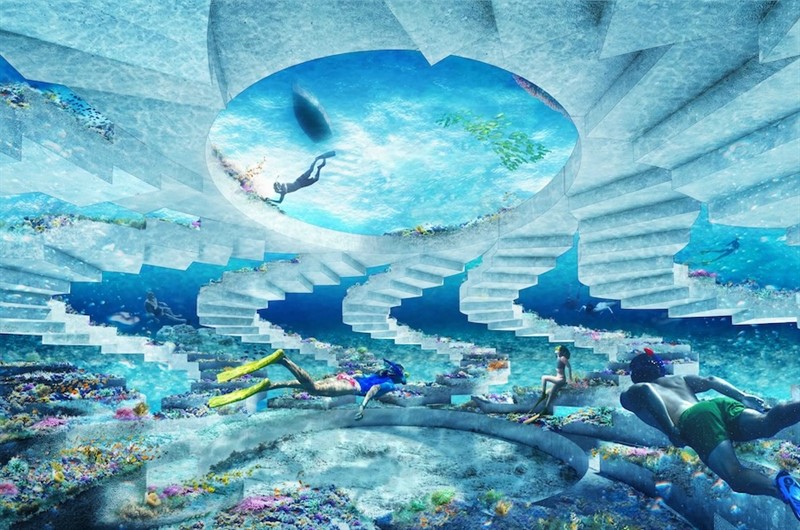
The cultural place-maker Ximena Caminos presents “marine acupuncture,” an innovative practice combining high art and deep science to target critical pressure points within our oceans and fostering environmental awareness through art and action-driven conservation. The ReefLine will be a 7-mile underwater public sculpture park, snorkel trail, and hybrid reef off Miami Beach’s shoreline. Conceived by Ximena Caminos and developed by the BlueLab Preservation Society, the ReefLine nonprofit team collaborates with the architecture firm OMA, as well as marine biologists, researchers, architects, and coastal engineers to design the master plan. Caminos’ lecture, followed by a conversation with Pedro Alonzo and Charles Waldheim, highlights how this pioneering approach uses human ingenuity to ignite ecological processes that regenerate the reef.
Established in 1986, the biennial Green Prize recognizes projects that make an exemplary contribution to the public realm of a city, improve the quality of life in that context, and demonstrate a humane and worthwhile direction for the design of urban environments. Eligible projects must include more than one building or open space constructed in the last 10 years.
The 15th Veronica Rudge Green Prize in Urban Design has been awarded to the Rwanda Institute for Conservation Agriculture (RICA) campus in Bugesera, Rwanda. With this award, the GSD acknowledges excellence in not just design but also process. Demonstrating a commitment to experimentation, the RICA project sets a new standard for evaluating innovation in the field of urban design. The project was realized through constant negotiation between city officials, motivated designers, and mobilized citizens. This process now serves as a model to educate other cities about implementation pathways. MASS led the master planning, architecture, landscape, engineering, furniture design and fabrication, and construction for the project.
For over 40 years, Bill McKibben has been raising the alarm about the climate crisis, starting with his groundbreaking book, The End of Nature. Now McKibben says, for once in his life, he is spreading good news. In his latest book, Here Comes the Sun, he explains why the recent boom in solar and wind power has given him hope for the planet's future, and he implores everyone to buy in. We hope you can join us for this inspiring and important conversation. This event is supported by the Melissa Kaish and Jonathan Dorfman Makers Fund. It is co-sponsored by the Salata Institute for Climate and Sustainability through its Climate Crossroads: Debating Energy’s Next Frontier series, bringing leading voices confronting the intertwined challenges of climate change and the global energy transition to Harvard University.
Friday 9/18 12pm-1pm - Introductory Presentation
Saturday 9/19 9am-5:30pm - GLG Workshop & Reception
The Global to Local to Global (GLG) Climate Mitigation Project, in collaboration with Esri, has initiated an innovative workflow to address climate change mitigation through a structured framework designed to implement global-to-local-to-global projects. The GLG strategy creates a scalable geodesign workflow compatible across global, Nationally Determined Contributions (NDCs) and diverse jurisdictions and geographic scales directed to projected environmental changes by 2050. It utilizes climate science and optimization designs to inform national to local designs– which, in turn, informs national and global policy, as local implementation is vital for building climate resilience.
Geodesign - design at geographic scale - provides a collaborative approach that integrates multiple disciplines and uses geographical information systems (GIS)-based analytic and design tools to help explore alternative future scenarios in response to stated problems. In this workshop, participants will work in groups to simulate commitments to climate mitigation projects at the regional or local scale, in consultation with national NDCs, climate, land use, land cover, and bio-regional data and their projections to 2050. Their selections will be used to quickly generate a global geospatial model of climate-driven scenarios resulting from combined mitigation actions, to which groups will be asked to respond to how global and national outcomes may inform future design conditions.
This in-person workshop is open to all from Harvard/MIT and participants from the broader academic community. No prior knowledge of GIS is required.