15th Veronica Rudge Green Prize: “Urban Design as a Development Strategy” Reception

Piper Auditorium, Gund Hall, GSD, 42 Quincy St., Cambridge

Established in 1986, the biennial Green Prize recognizes projects that make an exemplary contribution to the public realm of a city, improve the quality of life in that context, and demonstrate a humane and worthwhile direction for the design of urban environments. Eligible projects must include more than one building or open space constructed in the last 10 years.

The 15th Veronica Rudge Green Prize in Urban Design has been awarded to the Rwanda Institute for Conservation Agriculture (RICA) campus in Bugesera, Rwanda. With this award, the GSD acknowledges excellence in not just design but also process. Demonstrating a commitment to experimentation, the RICA project sets a new standard for evaluating innovation in the field of urban design. The project was realized through constant negotiation between city officials, motivated designers, and mobilized citizens. This process now serves as a model to educate other cities about implementation pathways. MASS led the master planning, architecture, landscape, engineering, furniture design and fabrication, and construction for the project.

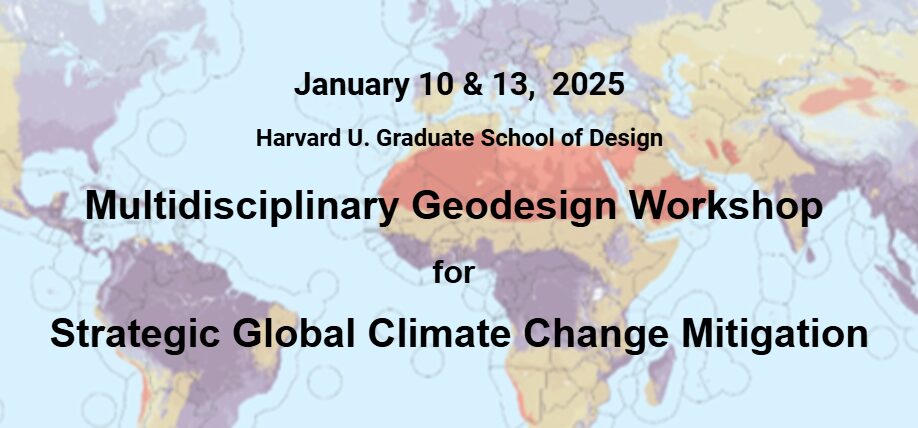
Multidisciplinary Geodesign Workshop for Strategic Global Climate Change Mitigation

Piper Auditorium, Gund Hall, GSD, 42 Quincy St., Cambridge

This 2-day workshop (January 10 and January 13) will expose participants from all schools, departments and disciplines at Harvard to an emergent data-driven geodesign framework for designing at the largest size imaginable – global – to identify feasible strategies to substantially reduce GHG emissions, the single most important global action available for countering cataclysmic global warming.

Participants will be assigned to represent national ‘climate-regions’ covering the entire globe (not necessarily their own, though local knowledge will help), focusing on a menu of possible climate mitigation project types, and their local and global spatial and temporal interconnections.) Based on initial proposed project-timelines of actions (Gantt charts) across the globe produced in Day 1, off-site computer simulations will be run over the weekend to predict likely climate modification outcomes. In Day 2, negotiation techniques will be used to find incremental improvements, resulting in an initial global strategic plan for carbon reduction.

No special prior experience is required. Geographic, cultural and disciplinary diversity is desired, and basic computer skills should suffice. A willingness to think big, and to engage in holistic systems thinking will help. We especially seek participants from or with experience in as many countries and climate regions as possible.

Our Artificial Nature: Perspectives on Design for an Era of Environmental Change

Piper Auditorium, Gund Hall, GSD, 42 Quincy St., Cambridge

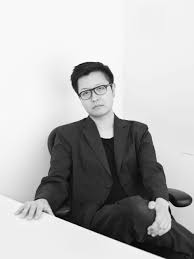
Carson Chan, curator of the concurrent MoMA exhibition Emerging Ecologies: Architecture and the Rise of Environmentalism, will engage GSD faculty in a conversation about past design speculations, current research, and practice futures.

The conversation will address the cultural, social, and technological processes emerging within design discourse that aim to address ecological imperatives. The event will call attention to the idea that design practice is the creation of the artificial, as well as the imagination of our constructed environment in a moment when our designed and natural worlds are fused. Both the event and exhibition aim to situate current research within a history of design for environmental change, framing new paradigms for environmental design.

This event is part of ArtsThursdays, a university-wide initiative supported by Harvard University Committee on the Arts (HUCA).